
FHIR vs OMOP vs openEHR
As healthcare becomes increasingly digital, the ability to store, share, and analyze health data is more critical than ever. Behind every Electronic Health Record (EHR), digital health app, or public health study lies a fundamental question:
How is healthcare data structured and standardized?
This is where three major standards come into play:
- FHIR (by Health Level Seven International - HL7)
- OMOP (by Observational Health Data Sciences and Informatics - OHDSI)
- openEHR (by openEHR Foundation)
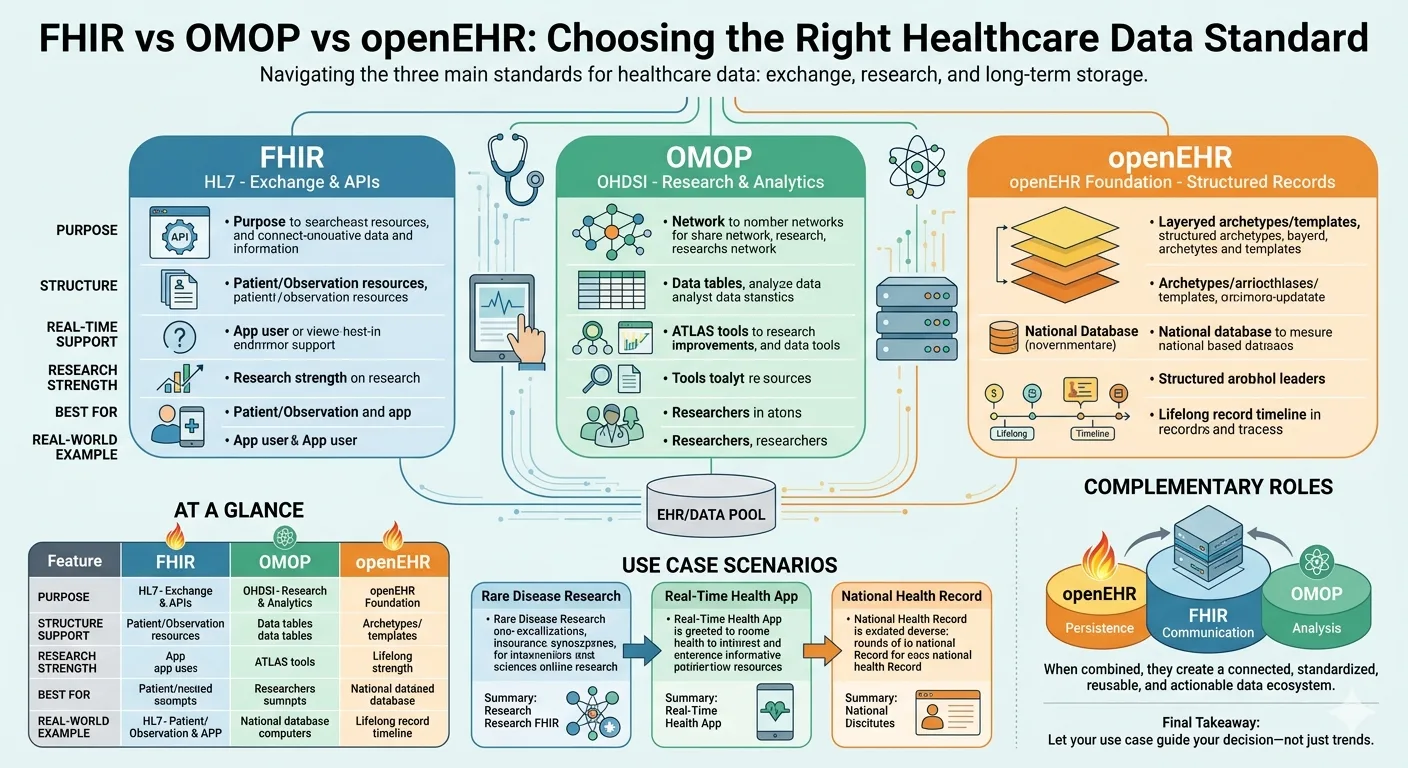
While often discussed together, these standards were designed with different purposes and philosophies:
- FHIR → Real-time interoperability
- OMOP → Research and analytics
- openEHR → Long-term structured clinical records
Understanding how they differ—and how they complement each other—is essential for healthcare IT professionals, researchers, and policymakers.
Quick Definitions
| Standard | Purpose | Maintained By |
|---|---|---|
| FHIR | Healthcare data exchange via APIs | HL7 |
| OMOP | Research & population health analytics | OHDSI |
| openEHR | Long-term structured EHR modeling | openEHR Foundation |
What is FHIR?
FHIR (Fast Healthcare Interoperability Resources) is a modern standard designed to make healthcare data exchange simple, fast, and interoperable using web technologies like REST APIs, JSON, and XML.
Key Features
- Modular Resources (Patient, Observation, Condition, etc.)
- API-first architecture
- Real-time data exchange
- Widely adopted by governments and vendors
Real-World Example
A mobile app for diabetes management retrieves:
- Blood glucose levels → Observation resource
- Medication data → MedicationRequest resource
FHIR enables seamless integration with hospital systems in real time.
Limitations
- Not ideal for analytics
- No standardized internal storage model
- Flexible structure can lead to inconsistent implementations
Best for: Interoperability, mobile apps, Health Information Exchanges (HIEs)
What is OMOP?
The OMOP Common Data Model (CDM) standardizes healthcare data for large-scale research and analytics.
Key Features
- Relational database schema optimized for SQL
- Standard vocabularies:
- SNOMED CT
- RxNorm
- LOINC
- Enables federated research networks
- Tools like ATLAS for analytics
Real-World Example
Researchers analyze the effect of a cholesterol drug on stroke outcomes across hundreds of hospitals using one standardized query.
Limitations
- Requires complex ETL pipelines
- Not real-time
- Limited support for detailed clinical narratives
Best for: Population health, research, multi-institutional analytics
What is openEHR?
openEHR is a specification and architecture designed for building semantically rich, lifelong electronic health records.
Key Features
- Two-level modeling:
- Archetypes (clinical concepts)
- Templates (use-case specific combinations)
- Strong versioning & audit trails
- Vendor-neutral data storage
- Semantic consistency across time
Real-World Example
A national health system builds a lifelong patient record where:
- Clinical meaning remains consistent across decades
- Data is reusable across systems without translation
Limitations
- Steep learning curve
- Requires governance for clinical modeling
- Smaller ecosystem compared to FHIR
Best for: National EHRs, long-term data storage, semantic interoperability
Comparison at a Glance
| Feature | FHIR | OMOP | openEHR |
|---|---|---|---|
| Primary Use | Data exchange | Research | Long-term EHR |
| Structure | Resources | Relational tables | Archetypes/Templates |
| Real-time | Yes | No | Yes |
| Research | Limited | Strong | Moderate |
| Customization | High | Low | High |
| Adoption | High | Medium | Growing |
Use Case Scenarios
1. Rare Disease Research
Need:
- Aggregate data across hospitals
- Standardize terminology
- Run analytics
Best Choice: OMOP
Enables federated queries and large-scale research.
2. Real-Time Health App Integration
Need:
- Access live patient data
- Integrate with hospital systems
Best Choice: FHIR
Provides API-driven, real-time interoperability.
3. National Health Record System
Need:
- Long-term data storage
- Semantic consistency
- Legal audit trails
Best Choice: openEHR
Ensures structured, lifelong patient records.
Can They Work Together?
Yes—modern architectures often combine all three:
Example Architecture
- openEHR → Data storage
- FHIR → Data exchange APIs
- OMOP → Research analytics
This approach maximizes:
- Interoperability
- Data quality
- Research capabilities
How to Choose
Your choice depends on your primary goal:
- Choose FHIR → If interoperability and APIs are your priority
- Choose openEHR → If you need structured, long-term clinical records
- Choose OMOP → If your focus is research and analytics
In many real-world systems, combining all three provides the best outcome.
Final Thoughts
FHIR, OMOP, and openEHR are not competing standards—they are complementary tools solving different problems:
- openEHR → Structure and persistence
- FHIR → Communication and integration
- OMOP → Analysis and research
When used together, they enable a healthcare ecosystem where data is:
- Connected
- Standardized
- Reusable
- Actionable
Let your use case guide your decision—not just trends or mandates.